
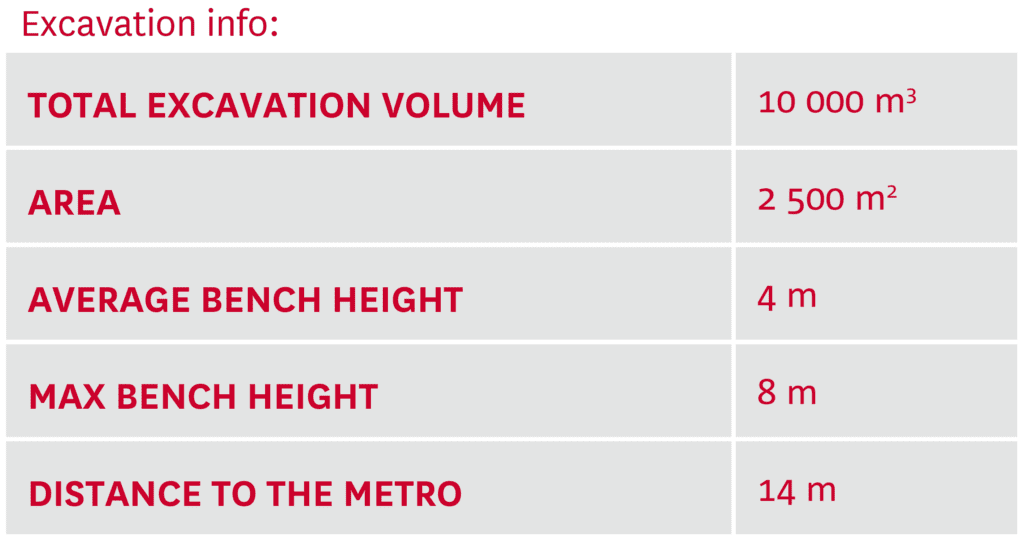
At the end of 2023, YIT’s site manager Henri Mattila faced a demanding construction project in the heart of Helsinki. The site was designated for a new health and wellness center, and its central location in Kamppi, combined with the proximity to metro tunnels, made the project particularly challenging. Due to the urban setting, the initial excavation plan involved wedging.
It soon became clear that excavation by wedging would be too slow, as the process would need to be carried out in multiple layers because of the eight-meter embankment height. However, based on preliminary studies, YIT was confident that blasting could be a viable method for excavation.
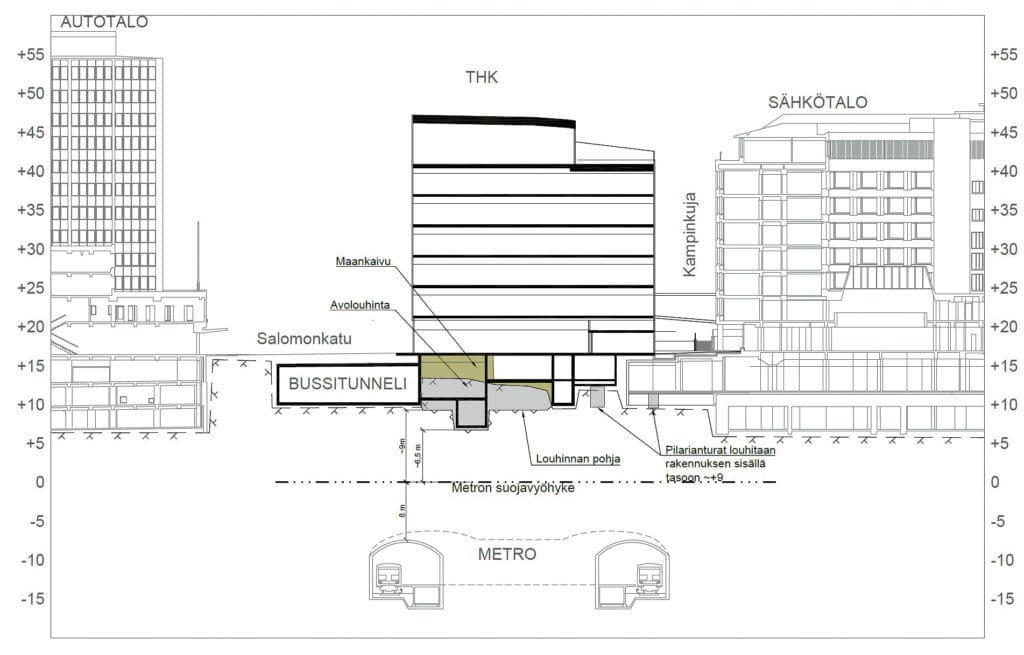
The geotechnical designer also considered blasting feasible, but additional data was needed to support the decision. The idea of conducting trial blasts emerged, which the client welcomed enthusiastically and commissioned YIT to carry out. Alvar Martiskainen from FORCIT’s technical services was involved in planning and executing the trial blasts. Three holes were drilled, and their straightness was measured. A total of five trial blasts were planned, starting with a very small charge designed to remain well below the theoretical vibration limits. The amount of explosives would be increased gradually if the vibrations stayed within acceptable limits. Vibration measurements were conducted by FORCIT Consulting Oy.
All trial blasts were successfully completed, with none of the measurement points exceeding the vibration thresholds. Alvar Martiskainen commented: “The planning and execution didn’t differ much from typical blasting in urban areas. The work was easy and enjoyable, as always!”.
Tables 1 and 2 present the results from several vibration measurement points. Measurement point MP02 was the most sensitive location in the metro, and vibrations were transmitted to the sensors differently depending on their positions. Surprisingly, the highest peak particle velocity (PPV) compared to the guideline value was recorded at the most distant sensors.
Table 1. Results from blast 1 with 0,175 kg charge.
| Distance [m] | Guideline value [mm/s] | PPV [mm/s] | Amplitude [um] | Component [%] | K-value | |
| METRO MP05L | 20 | 54,6 | 1,7 | 2 | 3,1 | 38 |
| Bus tunnel MP17V | 27 | 72,6 | 0,6 | 1 | 0,8 | 17 |
| METRO MP02V | 52 | 4,0 | 0,5 | 0 | 12,5 | 23 |
Table 2. Results from blast 4 with 0,525 kg charge.
| Distance [m] | Guideline value [mm/s] | PPV [mm/s] | Amplitude [um] | Component [%] | K-value | |
| METRO MP05L | 16 | 58,6 | 5,5 | 14 | 11,2 | 127 |
| Bus tunnel MP17V | 30 | 67,4 | 3,4 | 8 | 5,0 | 105 |
| METRO MP02V | 53 | 4,0 | 1,05 | 1 | 26,3 | 49 |
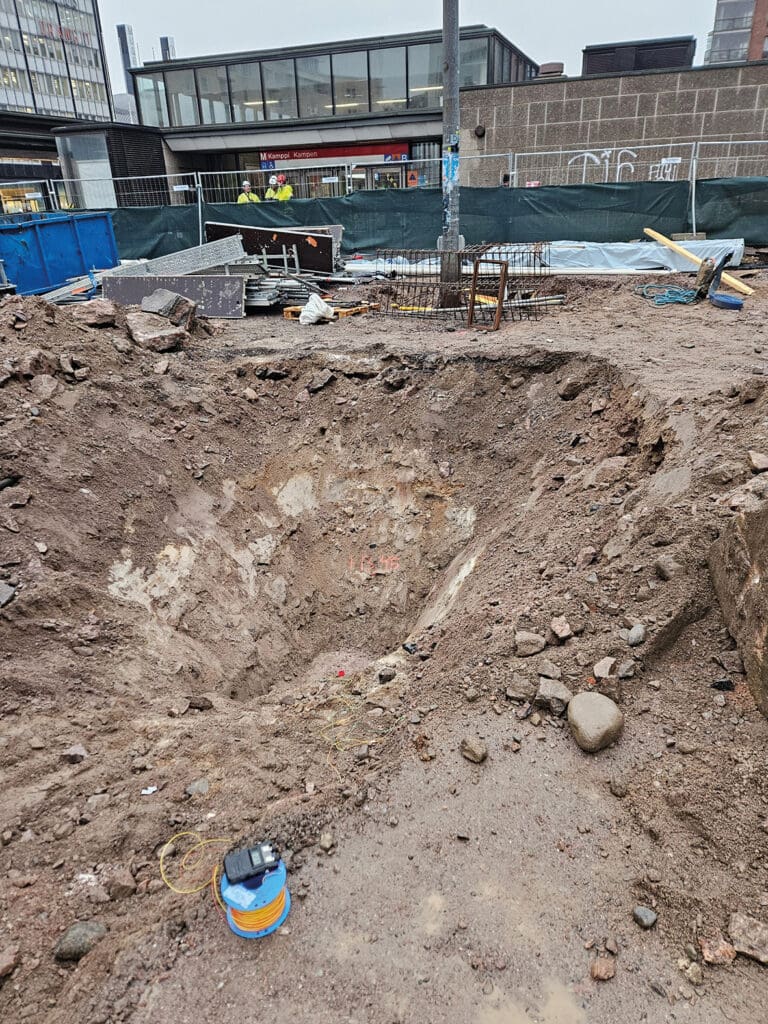
The trial blast results led to several conclusions. The metro was the most vibration-sensitive structure, and the vibrations transmitted to the underlying metro tunnels were weaker than predicted by theoretical models, meaning the K-value was lower than expected. Vibration levels remained well below the threshold even with 0.525 kg charges. Based on these results, YIT proposed that excavation could be carried out using drilling and blasting methods. The client was satisfied and approved the use of blasting. Excavation work at the site began in spring 2024 and has progressed according to schedule.
The key takeaway from the trial blasts is clear: even if the initial attitude toward blasting is negative, trial blasting is worth considering, as the results may surprise even the most cautious designer or client. Conducting trial blasts is generally recommended during the development phase of many project management contracts and alliance projects.
This article was published in Ruutiset 1/2024 (in Finnish).
Text: Henri Mattila, Anu Seppälä, Lari Laine
Images: PES-Arkkitehdit, YIT
What are the benefits of trial blasting in excavation projects?
Trial blasting can be used to assess the effects of blasting, such as vibration levels, before full-scale excavation work begins. The results help determine the most suitable excavation method for the site and verify that project requirements can be met.
What was learned from the Kamppi trial blasts?
The trial blasts demonstrated that excavation at the site could be carried out safely using the drilling and blasting method. Measured vibration levels remained well below the permitted limits, and based on the results, blasting was approved as the excavation method.