This article is based on an interview with a blaster who experienced a hazardous situation.
WHAT HAPPENED?
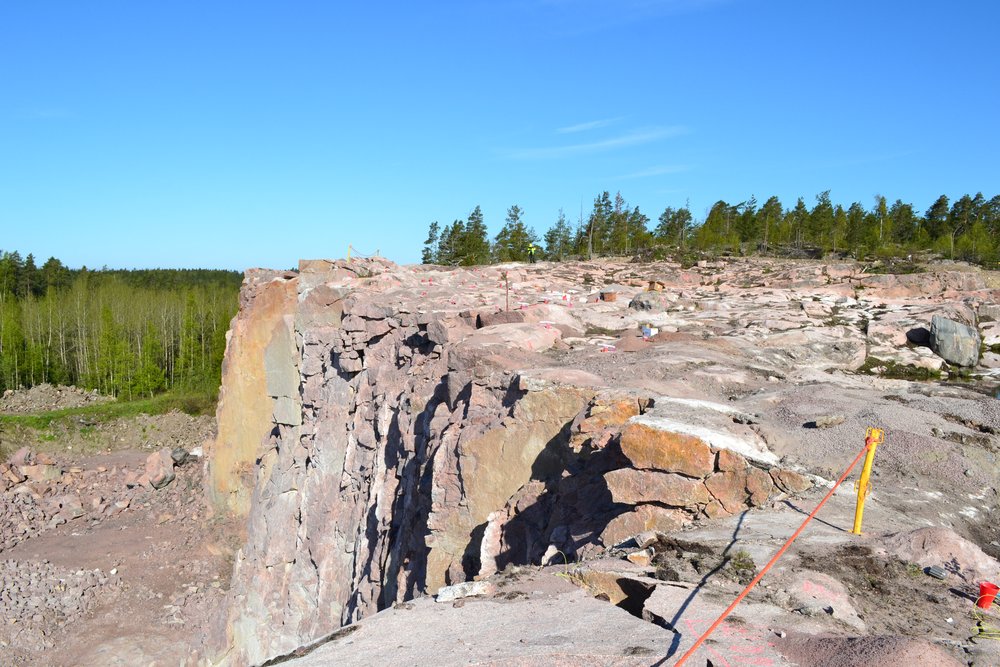
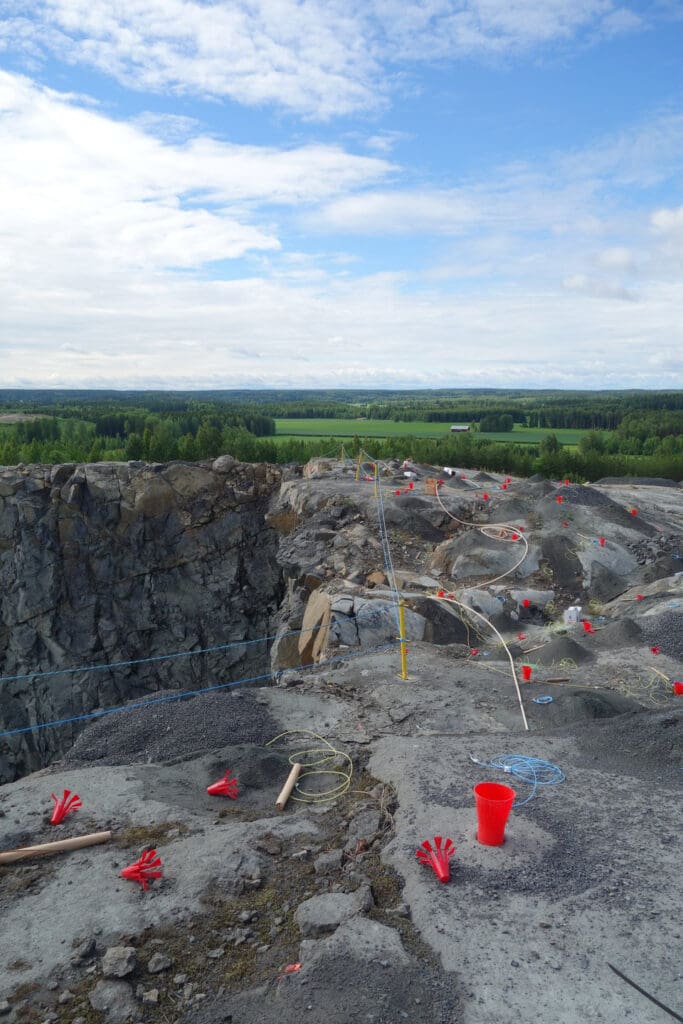
The incident occurred while the blaster was finishing the charging of a blast field, working on the final blast holes. To ensure the safety of the blast, they decided to go to the crest—the front edge of the blast field—to check that the hole was not too close to the free face, the open face of the rock to be blasted.
Suddenly, a large rock about 20 centimeters wide gave way under their foot. They nearly fell 12 meters down into a muckpile below. Fortunately, their other foot found a stable rock, and they managed to grab a charging hose from a nearby Kemiitti truck (emulsion charging vehicle). Thanks to the rock, the hose, and quick reflexes, a serious accident turned into a near miss.
The part of the crest where the blaster stepped appeared completely stable. There was nothing unusual about the spot, and no loose rock was visible where the collapse occurred. However, the rock quality in general was fractured. “The near miss definitely cost me a few nights of sleep. I don’t want to end up in a similar situation again, and I want to make sure no one else does either,” the blaster summarized.
CAN GOING NEAR THE CREST BE AVOIDED?
The most effective way to prevent this type of accident is to avoid going to the crest altogether. It is worth considering whether it is necessary to go there at all. As this case shows, visual inspection alone is not always enough to assess the stability of a foothold.
A safer approach would be to inspect the crest from the side or from below and mark where the wall is too thin. This inspection could be done in pairs, for example, with the driller or an assistant standing above the hole marking the spot, while the blaster assesses the wall thickness from below. The driller’s role is important, as they often plan the blast field, which can be problematic if they are not familiar with blasting.
Going to the crest can also be avoided if hole deviation measurements and scans have been performed. The resulting 3D model from the scan clearly shows the thickness of the burden.
DIFFERENT PROTECTIVE OPTIONS
According to Finnish law, fall protection is required when working at heights exceeding two meters or in any situation where a fall could result in a hazardous outcome.
The crest can be protected with fences or straps, but installing and removing them requires working near the crest, which forces the worker into a hazardous zone. From a safety perspective, personal protective equipment such as harnesses should be used during such preparatory and finishing tasks. Fall protection must be planned before fencing work begins, and the plan should also consider changing conditions like snow and ice. Protection must also be provided against falls in directions other than toward the free face.
Harnesses also protect against falls during charging work, especially when no other protection is available. However, it is important to remember that personal protective equipment is the last line of defense. At FORCIT, efforts have been made to improve the comfort and usability of harnesses by providing blasters with personal harnesses. A test system is also being trialed where the harness rope is attached to a cable between two poles or directly to a pole (Ruutiset 1/2021 and 2/2025).
When using fall protection harnesses, it is also important to consider how to respond after a fall. A person hanging in a harness cannot be pulled up by one or even two people. The fallen person can be supported or lifted from below using an excavator, but such equipment is not always available. The person should be lifted as quickly as possible, as the harness can compress vital blood vessels, and circulation may be dangerously restricted within 15–30 minutes if the person cannot reach a foot loop. Even after a shorter time hanging in a harness, a medical check-up is recommended, as impaired circulation can lead to blood clots. When initiating rescue operations, it is wise to take a brief moment to assess the situation to avoid causing further harm.
OTHER IDEAS TO PREVENT SIMILAR INCIDENTS
If the front row of holes has not been measured and cannot be accurately assessed, a viable alternative is to replace bulk explosive with cartridge explosive in holes that the blaster suspects are too close to the edge. For example, Kemix performs well in such front holes without causing excessive flyrock. For this approach, suitable explosives must be available on-site, so it is worth considering already when placing the explosives order.
WHAT INCREASES THE RISK OF SIMILAR ACCIDENTS?
As in many areas of life, haste and fatigue increase the risk of accidents in blasting work. Charging days are often long and physically demanding, and at the end of the day, it can be tempting to cut corners—such as “just quickly checking the crest.” Even in those moments, safety should remain the top priority.
There may also be ingrained work habits and mindsets that go unquestioned. “The blaster has to go to the edge” might feel like an obvious truth, but even such assumptions should be challenged when safety is at stake. There is often a conflict between ideal safety thinking and practical or cost-related realities. Therefore, it is important to improve safety with genuinely effective solutions—not with superficial measures that look good on paper but do not work in practice. Ultimately, ensuring the safety of blasters depends heavily on advance planning. A well-drilled field or one with an available 3D model is a safer work environment. It would also be beneficial to have a designated person responsible for overseeing safety at the site.
This article was published in Ruutiset 2/2021 (in Finnish).
Text: Saila Pesonen
Images: FORCIT Explosives
How can the risk of falling be reduced during charging operations?
The risk of falling can be reduced by avoiding unnecessary movement near the edge of the rock face, utilising tools such as borehole deviation measurements and 3D modelling, and using appropriate fall protection equipment when required.
What can contribute to hazardous situations during charging operations?
Hazardous situations can be caused by factors such as haste, fatigue, inadequate advance planning, and established working practices that are not questioned from a safety perspective.